


 English
 русский

Content
- 1 Understanding 301 Stainless Steel: Composition and Metallurgical Basis
- 2 Temper Designations and Their Mechanical Property Ranges
- 3 How 301 Stainless Steel Strip Compares to 304 and 302 Grades
- 4 Primary Industrial Applications of 301 Stainless Steel Strips
- 5 Surface Finish Options and Their Functional Significance
- 6 Sourcing Considerations and Quality Verification for 301 Strip
Understanding 301 Stainless Steel: Composition and Metallurgical Basis
301 stainless steel is an austenitic chromium-nickel stainless steel alloy that belongs to the 300 series family, which is characterized by its face-centered cubic crystal structure and non-magnetic properties in the annealed condition. The nominal chemical composition of 301 stainless steel includes 16–18% chromium, 6–8% nickel, a maximum of 0.15% carbon, and the balance iron, with small controlled additions of manganese, silicon, phosphorus, and sulfur within defined limits. Compared to the more widely specified 304 grade, 301 contains lower chromium and nickel content, which is a deliberate design choice rather than a cost-cutting measure — the reduced alloying element content makes 301 significantly more responsive to cold working, allowing its mechanical properties to be substantially enhanced through controlled cold reduction without the need for heat treatment.
The metallurgical mechanism behind 301's exceptional work-hardening response is the strain-induced martensitic transformation. When 301 stainless steel is cold worked — rolled, drawn, or formed — the applied stress causes a portion of the austenite phase to transform into martensite, a harder and stronger phase with a body-centered tetragonal crystal structure. This transformation is progressive: the greater the degree of cold reduction applied, the more martensite forms, and the higher the resulting tensile strength and hardness of the strip. This behavior gives engineers a powerful tool for tailoring the mechanical properties of 301 strip to specific application requirements by specifying the appropriate temper condition, without changing the alloy composition or applying heat treatment after forming.
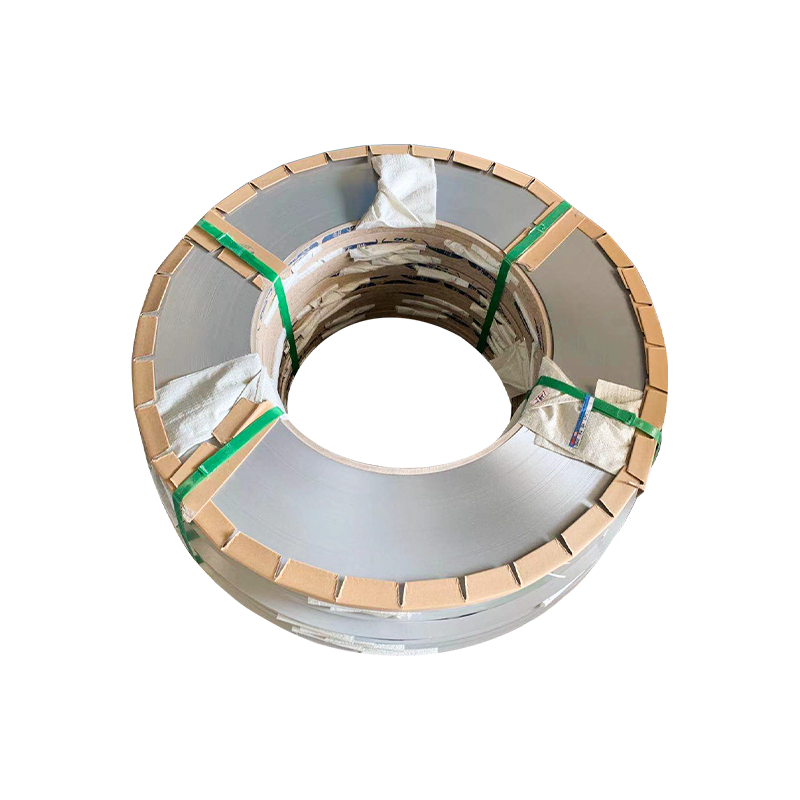
Temper Designations and Their Mechanical Property Ranges
The defining commercial feature of 301 stainless steel strip is its availability across a wide range of temper conditions, each corresponding to a specific degree of cold rolling reduction and a defined range of mechanical properties. Understanding these temper designations is essential for engineers specifying 301 strip, as selecting the wrong temper is one of the most common causes of performance problems in spring, fastener, and structural component applications.
| Temper Designation | Cold Reduction (%) | Tensile Strength (MPa) | Yield Strength (MPa) | Typical Use |
| Annealed (1/4 Hard equivalent) | 0 | ≥ 515 | ≥ 205 | Deep drawing, complex forming |
| 1/4 Hard | ~11 | 760 – 1000 | 515 – 760 | Mild springs, clips, formed parts |
| 1/2 Hard | ~21 | 1035 – 1275 | 760 – 1035 | Springs, structural brackets |
| 3/4 Hard | ~36 | 1170 – 1410 | 965 – 1240 | High-load springs, clamps |
| Full Hard | ~60 | ≥ 1275 | ≥ 1035 | Maximum strength strip springs |
| Extra Full Hard | >60 | ≥ 1550 | ≥ 1380 | Precision flat springs, blades |
It is important to note that as temper increases and tensile strength rises, the material's ductility and formability decrease correspondingly. Full hard and extra full hard 301 strip can be bent only to limited radii without cracking, and forming operations must be carefully engineered to work within the material's reduced elongation. The springback behavior also increases significantly in harder tempers, requiring die compensation during stamping and forming operations to achieve target final dimensions.
How 301 Stainless Steel Strip Compares to 304 and 302 Grades
Engineers frequently face the decision of whether to specify 301, 302, or 304 stainless steel strip for a given application, and the differences between these grades — while subtle in composition — are significant in practical performance. Understanding these distinctions prevents over-specification of more expensive or corrosion-resistant grades where 301 is fully adequate, and equally prevents under-specification of corrosion resistance in environments where 301's limitations become relevant.
301 vs. 304 Stainless Steel Strip
304 stainless steel contains 18–20% chromium and 8–10.5% nickel — higher alloying content than 301 — which gives it superior corrosion resistance, particularly in moderately aggressive chemical environments and in applications with prolonged exposure to moisture, cleaning chemicals, or mild acidic conditions. However, 304's higher alloy content also makes it more stable against martensitic transformation during cold working, meaning it work-hardens more slowly and achieves lower maximum tensile strengths than 301 at equivalent cold reduction levels. For spring and high-strength structural applications where corrosion resistance requirements are moderate — indoor environments, protected enclosures, and applications with periodic cleaning — 301 delivers significantly higher strength at lower material cost. For food processing, medical, or aggressive outdoor environments, 304 or the higher molybdenum-containing 316 grade is the more appropriate specification.
301 vs. 302 Stainless Steel Strip
302 stainless steel is compositionally very close to 301 but contains slightly higher carbon content (maximum 0.15% vs. 0.15% nominal for 301, with 302 historically allowing up to 0.15% and some specifications permitting up to 0.12% for 301). In practice, 301 and 302 are often used interchangeably for spring and formed part applications, and many strip mills produce material that meets both specifications simultaneously. The primary distinction is that 302 has a marginally higher work-hardening rate in some production runs, and legacy engineering drawings sometimes specify 302 based on historical material availability rather than a performance-critical compositional requirement. When sourcing strip for new designs, 301 is generally the preferred specification due to its more widespread availability and better-defined temper property ranges in current international standards.
Primary Industrial Applications of 301 Stainless Steel Strips
The combination of high achievable strength, good corrosion resistance, and excellent surface finish makes 301 stainless steel strip one of the most versatile precision strip materials across multiple manufacturing sectors. Its applications span industries from transportation and electronics to medical devices and consumer goods, wherever components require a high strength-to-weight ratio, spring-back reliability, and resistance to atmospheric corrosion.
- Flat and Coil Springs: 301 strip in 1/2 hard to extra full hard temper is the preferred material for flat springs, clock springs, retaining springs, and constant force springs used in automotive assemblies, electronic connectors, appliance mechanisms, and industrial equipment. The high yield strength ensures that springs maintain their load characteristics over millions of deflection cycles without taking a set, while the corrosion resistance eliminates the need for protective coatings that would add cost and thickness tolerance variability.
- Hose Clamps and Band Clamps: The automotive and plumbing industries use 301 stainless steel strip extensively for worm-drive hose clamps, ear clamps, and band clamps. Full hard 301 strip provides the high hoop stress necessary for effective sealing at hose connections while resisting the corrosion caused by road salt, engine fluids, and outdoor exposure. The material's magnetic response in the cold-worked condition — a consequence of the strain-induced martensite — is typically not a concern in clamp applications but should be noted for applications where magnetic neutrality is required.
- Fasteners and Stampings: Screws, washers, retaining rings, and complex stampings produced from 301 strip benefit from the material's good cold formability in annealed and 1/4 hard temper, combined with the ability to develop high final strength through the forming operation itself. Self-tapping screws and thread-rolling fasteners made from 301 strip achieve thread form hardness levels that would require additional heat treatment steps if produced from lower work-hardening alloys.
- Structural Reinforcement Components: Automotive body reinforcements, door intrusion beams, and seat frame components increasingly use 301 strip in full hard temper as a weight-reduction strategy. The material's high tensile strength allows component cross-sections to be reduced relative to mild steel equivalents while meeting equivalent or superior crash performance requirements, contributing to vehicle lightweighting programs targeting improved fuel economy and reduced CO₂ emissions.
- Electronic and Electrical Components: Battery contact springs, connector terminals, shielding clips, and flexible circuit support members are produced from thin-gauge 301 strip in precision-slit widths. The material's excellent surface finish, tight thickness tolerances achievable in precision cold rolling, and consistent electrical conductivity make it suitable for components where dimensional and electrical performance consistency are critical to product reliability.
Surface Finish Options and Their Functional Significance
301 stainless steel strip is available in several surface finish conditions, and the appropriate finish selection depends on the application's functional requirements, aesthetic demands, and any subsequent surface treatment or coating operations planned by the fabricator. The surface finish influences not only appearance but also friction characteristics, fatigue life, adhesion of coatings and adhesives, and corrosion resistance in borderline exposure conditions.
- 2B Finish: The standard mill finish for cold-rolled stainless steel strip, produced by a final light cold rolling pass on polished rolls followed by annealing and pickling. 2B is a smooth, moderately reflective finish suitable for most industrial applications and serves as the starting point for further polishing or surface treatment. It is the most widely available and cost-effective finish specification.
- BA (Bright Annealed) Finish: Produced by annealing in a controlled hydrogen or nitrogen atmosphere to prevent surface oxidation, followed by rolling on highly polished rolls. BA finish has a mirror-like reflectivity and very low surface roughness (Ra typically below 0.1 µm), making it the preferred finish for decorative applications, precision optical components, and situations where the lowest possible surface roughness is required for contact or sealing functions.
- No. 4 Brushed Finish: A unidirectional brushed finish produced by polishing with progressively finer abrasive belts, resulting in a consistent linear grain pattern. No. 4 finish is widely specified for architectural trim, consumer appliance components, and any application where a consistent brushed appearance is desired. It is less reflective than BA but more visually consistent and scratch-concealing than 2B.
Sourcing Considerations and Quality Verification for 301 Strip
Procuring 301 stainless steel strip for precision applications requires careful attention to mill certification, dimensional tolerance verification, and temper consistency across coil lots. The consequences of receiving out-of-specification material — whether in terms of tensile strength, thickness, width, or surface quality — can range from increased scrap rates in stamping and forming operations to field failures of springs or structural components that have been designed to tight performance margins.
When evaluating suppliers, request mill test certificates (MTCs) in accordance with EN 10204 Type 3.1 or equivalent, which provide certified chemical composition and mechanical property test results from the specific heat and coil lot being supplied. For temper-rolled strip, verify that the mechanical property values reported on the MTC fall within the specified ranges for the ordered temper, and request that the test method (gauge length, specimen orientation relative to rolling direction) complies with a recognized standard such as ASTM A666 or EN 10151. Thickness and width tolerances should be confirmed against the applicable standard — ASTM A666 and EN 10151 both define tolerance tables for various width and thickness combinations — and incoming inspection should include micrometer measurements at multiple points across the coil width to detect any crown or edge taper that could affect forming consistency.
For high-volume precision applications, consider qualifying suppliers through a first article inspection process that includes not only dimensional and mechanical property verification but also a trial stamping or forming run to confirm that the material performs consistently through the planned production process. Surface defects such as pits, scratches, roll marks, and edge burrs should be evaluated against acceptance criteria defined in the purchase specification before committing to a full production order. Establishing a long-term supply relationship with a precision strip mill that maintains tight coil-to-coil consistency is ultimately more valuable than optimizing unit price at the expense of incoming quality variability, particularly for spring and fastener applications where material inconsistency translates directly into product performance variability and warranty exposure.
 Previous


