


 English
 русский

Content
- 1 The Origin of the 304/304L Dual Designation
- 2 The Core Difference: Carbon Content
- 3 Why Mills Produce Dual-Certified Material
- 4 Comparing 304 and 304L Side by Side
- 5 Applications of 304/304L Stainless Steel Strips
- 6 When the Grade Distinction Actually Matters
- 7 How to Specify 304/304L Strip Correctly
- 8 The Bottom Line on the 304/304L Pairing
The Origin of the 304/304L Dual Designation
Walk through any stainless steel supplier catalog or mill certificate, and you will frequently encounter the combined notation "304/304L." For buyers and engineers unfamiliar with metallurgical standards, this pairing can be puzzling. Are these two different materials? Are they interchangeable? The answer lies in the subtle but meaningful difference in carbon content between the two grades — and in the practical realities of how stainless steel strips are produced, certified, and sold across industries worldwide.
Both 304 and 304L belong to the austenitic family of stainless steels and share a foundational composition of approximately 18% chromium and 8% nickel. Their chemical and mechanical properties are nearly identical in most service conditions, which is exactly why manufacturers and distributors find it efficient — and commercially sensible — to treat them as a unified product offering.
The Core Difference: Carbon Content
The defining distinction between 304 and 304L is the maximum allowable carbon content specified by standards such as ASTM A240 and EN 10088. Standard 304 permits up to 0.08% carbon, while 304L (the "L" stands for "low carbon") restricts carbon to a maximum of 0.03%. This difference of just a few hundredths of a percent has a significant impact in specific processing environments — particularly those involving welding or exposure to elevated temperatures.
When stainless steel is heated to the sensitization range — roughly 427°C to 816°C (800°F to 1500°F) — carbon atoms can migrate to grain boundaries and combine with chromium to form chromium carbides. This process depletes the surrounding metal of the chromium needed for corrosion resistance, creating a condition known as sensitization. Sensitized stainless steel becomes vulnerable to intergranular corrosion, particularly in acidic or chloride-rich environments. By limiting carbon to 0.03%, 304L significantly reduces this risk without requiring post-weld heat treatment.
Why Mills Produce Dual-Certified Material
Modern steelmaking precision has advanced to the point where many mills routinely produce heats of stainless steel that satisfy both the 304 and 304L carbon requirements simultaneously. When a heat is melted with carbon content at or below 0.03%, it automatically meets the 304L specification. If that same heat also satisfies the mechanical property requirements for 304 (which 304L sometimes falls slightly short of due to its lower carbon strengthening effect), the material can be dual-certified and marked as "304/304L."
This dual certification is not a workaround or a compromise — it is a legitimate and widely accepted practice under ASTM, EN, and JIS standards. For stainless steel strip producers, it offers significant logistical advantages: a single coil of material can serve customers who need standard 304 and customers who specifically require the low-carbon 304L grade, without maintaining separate inventory for each.
What Dual Certification Means for the Buyer
When you purchase 304/304L stainless steel strips, you are receiving material that meets the stricter carbon limit of 304L while also satisfying the broader requirements of 304. In practice, this gives you the corrosion resistance advantage of low-carbon steel at no additional cost or lead time. For most non-welded applications, the distinction is academic. For welded assemblies or chemical processing equipment, the low carbon content provides meaningful added protection.
Comparing 304 and 304L Side by Side
The following table summarizes the key differences and similarities between 304 and 304L stainless steel according to ASTM A240 specifications:
| Property | 304 | 304L |
| Max Carbon (%) | 0.08 | 0.03 |
| Chromium (%) | 18.0 – 20.0 | 18.0 – 20.0 |
| Nickel (%) | 8.0 – 10.5 | 8.0 – 12.0 |
| Min Tensile Strength (MPa) | 515 | 485 |
| Min Yield Strength (MPa) | 205 | 170 |
| Weld Sensitization Risk | Moderate | Low |
| Dual Certification Possible | Yes | Yes |
Applications of 304/304L Stainless Steel Strips
Stainless steel strips in the 304/304L grade are among the most broadly used precision materials in manufacturing. Their combination of corrosion resistance, formability, and surface finish versatility makes them suitable for an enormous range of end uses. Common application sectors include:
- Food and beverage processing: Conveyor belts, slitter blades, canning line components, and hygienic enclosures benefit from the grade's ease of cleaning and resistance to mild organic acids.
- Medical and pharmaceutical equipment: Instrument springs, surgical tool blanks, and sterile container closures are frequently produced from cold-rolled 304/304L strip due to its biocompatibility and ability to withstand repeated sterilization cycles.
- Electronic components: EMI shielding, connector housings, and precision stampings for consumer electronics rely on the dimensional consistency and surface quality achievable with 304/304L strip in tight tolerances.
- Architecture and construction: Trim strips, cladding fixings, and decorative profiles use the grade for its aesthetic qualities and long-term resistance to atmospheric corrosion.
- Chemical and petrochemical sectors: Where welding is involved, the low-carbon 304L characteristic is particularly valued to prevent intergranular attack in service environments containing dilute acids or chlorides.
When the Grade Distinction Actually Matters
For the vast majority of 304/304L strip applications — stamping, forming, bending, roll forming, and non-welded assembly — the carbon difference between 304 and 304L has no practical effect. Both grades will perform identically in ambient temperature service environments where sensitization is not a concern. However, there are specific situations where specifying 304L (or confirming dual certification) becomes technically important:
- Heavy or multi-pass welding: Extended heat input during fabrication raises the risk of sensitization in standard 304. A confirmed 304L carbon level removes this risk without the need for post-weld annealing.
- Cryogenic service: Both grades perform well at low temperatures, but 304L's slightly higher nickel range can offer marginal toughness benefits in extreme cold applications.
- Regulatory compliance: Certain pressure vessel codes, nuclear standards, or pharmaceutical equipment specifications explicitly call for 304L by grade designation, requiring a clearly documented low-carbon certification.
- Highly corrosive media: In contact with nitric acid, sulfuric acid solutions, or marine environments over extended periods, the reduced sensitization risk of 304L provides measurable service life benefits for welded assemblies.
How to Specify 304/304L Strip Correctly
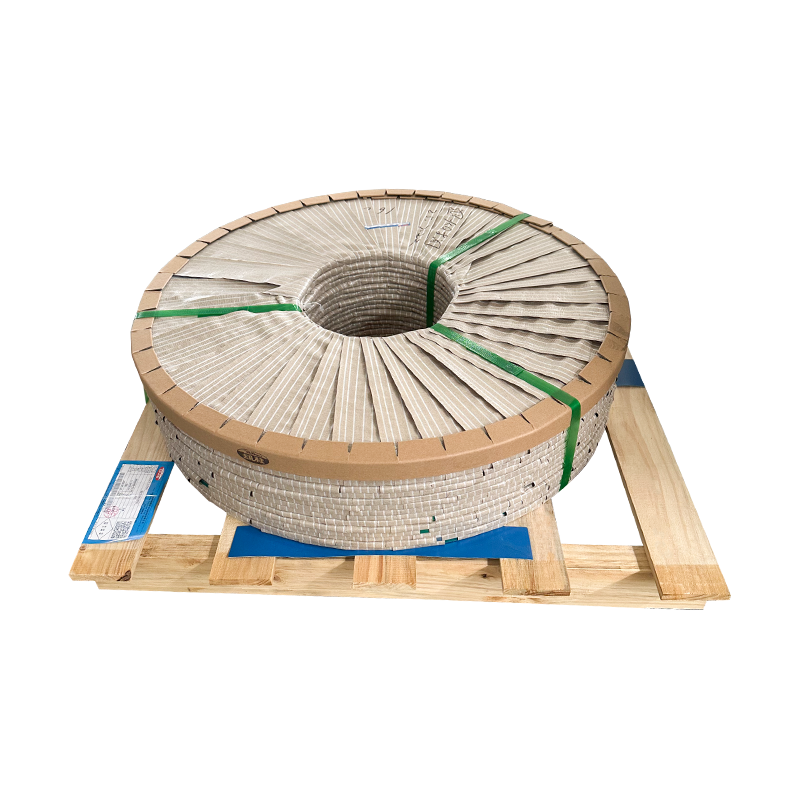
When sourcing stainless steel strips, clear specification avoids both over-engineering and under-performance. If your application involves no welding and no elevated-temperature exposure, specifying "304 or 304/304L per ASTM A240" gives your supplier flexibility to supply from dual-certified stock — often resulting in faster delivery and better pricing. If your design involves welding, explicitly call out 304L or request a dual-certified test certificate confirming carbon content at or below 0.03%.
Beyond the grade designation, a complete strip specification should also address thickness tolerance (typically per ASTM A480 or EN 10259), width tolerance, surface finish (2B, BA, No. 4, No. 8, or other), temper condition (annealed, quarter-hard, half-hard, full-hard), and coil or cut-to-length format. These parameters often have more impact on downstream fabrication results than the 304 vs. 304L distinction alone.
The Bottom Line on the 304/304L Pairing
The combined "304/304L" designation in stainless steel strip products is a reflection of modern manufacturing capability, not ambiguity. When a mill achieves low enough carbon to satisfy both grades simultaneously, dual certification is the natural and commercially rational outcome. For buyers, this means they frequently receive the corrosion resistance advantage of 304L at the standard 304 price point, from standard 304 stock. Understanding this pairing helps engineers specify more confidently, procurement teams source more efficiently, and quality teams review mill certifications with a clearer framework. Whether you are stamping precision components, fabricating welded enclosures, or supplying slit coils to downstream processors, knowing why 304 and 304L are listed together — and when that distinction truly matters — is fundamental knowledge for anyone working with stainless steel strip materials.
 Previous


