


 English
 русский

What Makes 304 Cold Rolled Stainless Steel Strip the Right Material for Hypodermic Needle Manufacturing?
Hypodermic needles are among the most precision-critical components in medical device manufacturing. Every millimeter of the finished tube must meet strict dimensional tolerances, surface finish standards, and biocompatibility requirements before it is considered safe for clinical use. The raw material that makes this possible — 304 cold rolled stainless steel strip — is selected not by default but because its combination of mechanical properties, chemical composition, and processing characteristics aligns precisely with what needle tube forming demands. Understanding why this alloy in this condition is the industry standard helps procurement teams, quality engineers, and medical device manufacturers make more informed sourcing and specification decisions.
The Role of Grade 304 Stainless Steel in Medical Applications
Grade 304 stainless steel is an austenitic alloy belonging to the 300 series, defined by its nominal composition of 18% chromium and 8% nickel alongside an iron base. This composition gives the alloy its characteristic combination of corrosion resistance, formability, and mechanical strength. In medical device applications, the chromium content is what forms the passive oxide layer on the surface — a microscopically thin film that resists oxidation, prevents ion leaching into biological tissue, and provides the chemical inertness required for contact with blood and bodily fluids.
For hypodermic needle production specifically, Grade 304 offers several properties that competing alloys such as 316L or ferritic grades cannot fully replicate at equivalent cost. Its austenitic microstructure makes it non-magnetic under normal conditions, which is relevant for MRI-compatible device considerations. It work-hardens progressively during cold rolling and tube drawing, allowing manufacturers to achieve the thin-wall, high-strength geometry a needle cannula requires. And its weldability supports the tube-seam welding process used in most large-scale needle tube production lines.
Why Cold Rolling Matters for Strip Destined for Needle Tubes
Cold rolling refers to the process of reducing strip thickness by passing it through hardened rolls at room temperature, below the material's recrystallization point. Unlike hot rolling, which is performed at elevated temperatures and produces a scaled, dimensional rougher surface, cold rolling refines the grain structure and imparts a smooth, tight surface finish while improving dimensional accuracy and mechanical strength simultaneously.
Surface Finish and Cleanliness
The surface quality of the input strip directly determines the interior surface quality of the finished needle tube. When strip is formed into a tube by roll forming and seam welding, the original strip surface becomes the bore of the cannula — the channel through which medication or biological samples travel. Any surface defects, pits, or scale inclusions on the cold rolled strip can translate into irregularities on the bore surface that affect fluid flow, increase the risk of particulate contamination, and complicate subsequent electropolishing operations. Cold rolled 304 strip for needle applications is typically supplied with a No. 2B or BA (bright annealed) finish, both of which provide the low surface roughness values — Ra below 0.5 µm in most specifications — required for downstream tube processing.
Dimensional Precision Across the Coil
Needle tube forming is a continuous process where strip is fed from a coil into a roll forming station at high speed. Thickness variation across the width or along the length of the strip causes wall thickness inconsistencies in the finished tube, which in turn affects needle gauge accuracy and structural integrity. Precision cold rolled strip for needle applications is held to tight thickness tolerances — typically ±0.005mm to ±0.010mm on strip thicknesses between 0.10mm and 0.40mm — and crown (thickness differential between center and edge) is controlled to ensure uniform forming across the full strip width.
Key Technical Specifications for 304 Strip Used in Hypodermic Needle Production
Procurement specifications for medical-grade 304 cold rolled strip are more stringent than those for general industrial applications. The table below summarizes the principal parameters buyers and quality teams should specify and verify:
| Parameter | Typical Requirement | Relevance to Needle Manufacturing |
| Thickness Range | 0.10mm – 0.40mm | Determines wall thickness of finished cannula |
| Thickness Tolerance | ±0.005mm – ±0.010mm | Controls gauge consistency across production runs |
| Surface Finish | No. 2B or BA, Ra ≤ 0.5 µm | Ensures clean bore surface after tube forming |
| Carbon Content (max) | 0.08% (per ASTM A240) | Low C prevents sensitization during welding |
| Tensile Strength | 515 MPa minimum (annealed) | Provides structural strength in thin-wall tube |
| Hardness | ≤ 92 HRB (annealed condition) | Enables subsequent drawing and forming operations |
| Inclusion Rating | Per ASTM E45 Method A, thin series ≤ 1.5 | Minimizes crack initiation sites during drawing |
It is also standard practice to request mill test certificates (MTCs) with full chemical composition traceability for each coil or batch, particularly when the finished needles will require regulatory documentation under ISO 13485 or FDA 21 CFR Part 820 quality systems.
From Strip to Needle Tube: Understanding the Forming Process
Hypodermic needle tubes are manufactured through a process known as strip-to-tube roll forming combined with laser or high-frequency welding. The cold rolled 304 strip is slit to the precise width required for the target tube outer diameter, then fed continuously through a series of forming rolls that progressively curl the flat strip into a tubular profile. At the point where the two strip edges meet, a weld is applied — typically using a laser beam or high-frequency induction current — fusing the seam with minimal heat input to preserve the surrounding material properties.
Following seam welding, the tube undergoes a series of cold drawing passes through carbide dies to reduce the outer diameter and wall thickness to the final needle gauge dimensions. This drawing process further work-hardens the material, increasing tensile strength and hardness while refining the tube's circularity and surface finish. Between drawing passes, annealing may be applied to restore ductility and prevent cracking. The inner surface is cleaned by electrolytic or chemical means, and the tube may be subjected to bright annealing in a hydrogen atmosphere to achieve the final mirror-like bore finish required for medical use.
Sourcing Considerations for Medical-Grade 304 Strip
Not all 304 stainless steel strip on the market is appropriate for hypodermic needle production. The medical device supply chain demands a higher level of material traceability, consistency, and certification than most industrial applications. When evaluating suppliers, buyers should consider the following factors:
- Confirm that the supplier operates under a recognized quality management system such as ISO 9001 or, preferably, ISO 13485 for medical device component suppliers.
- Require full material traceability from melt heat number through to the finished coil, enabling complete chain-of-custody documentation for regulatory audits.
- Request inclusion and cleanliness testing results per ASTM E45 or equivalent, as high inclusion ratings are a leading cause of tube cracking during multi-pass drawing.
- Verify that the supplier can consistently hold the specified slit width tolerance — typically ±0.02mm — since slit width deviation directly affects the tube outer diameter after forming.
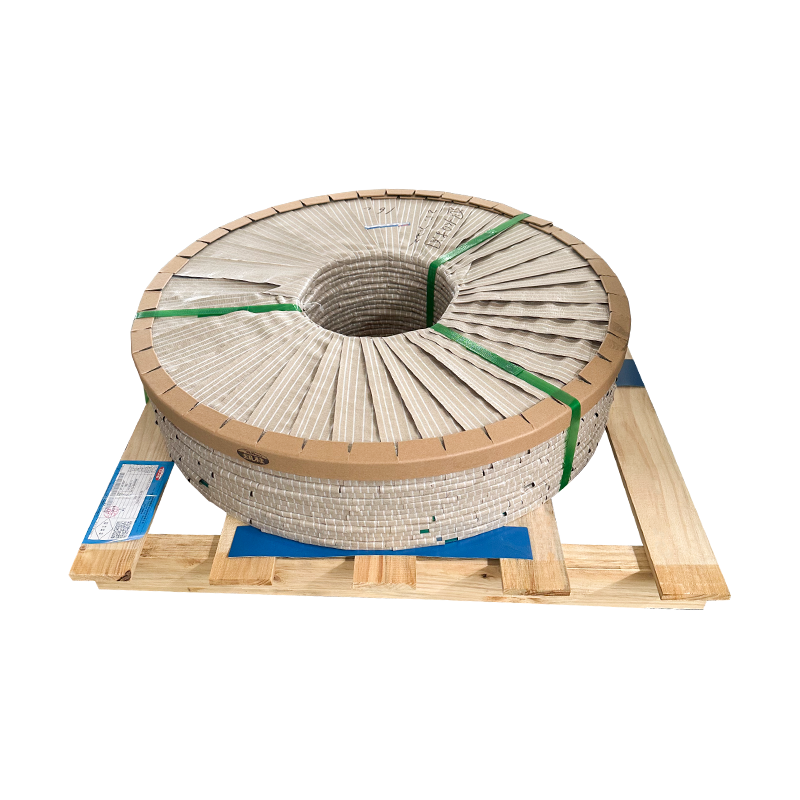
- Assess the supplier's coil packaging and handling standards to prevent edge damage, moisture ingress, and surface contamination during transit and storage.
Comparing 304 with Alternative Alloys for Needle Strip Applications
While 304 is the dominant alloy for standard hypodermic needle production, other grades are used in specific applications where performance requirements differ. Grade 316L — with added molybdenum and lower carbon content — offers improved resistance to pitting corrosion in chloride environments and is preferred for needles intended for implantable or long-dwell applications. However, 316L is harder to form in very thin gauges and carries a higher material cost, making it less practical for the high-volume disposable needle market where 304 dominates.
Grade 301, with lower nickel content than 304, work-hardens more rapidly during cold drawing, which can be advantageous for applications requiring maximum hardness in the finished tube wall. However, its lower corrosion resistance compared to 304 limits its use in medical contexts where the passive layer integrity is non-negotiable. For the vast majority of single-use hypodermic needles produced globally — from insulin syringes to blood collection sets — cold rolled 304 strip remains the material of choice, striking the optimal balance between performance, processability, regulatory acceptance, and cost efficiency at scale.
 Previous


