


 English
 русский

Content
- 1 What Is 301 Stainless Steel and Why Is It Used for Springs?
- 2 Chemical Composition and Its Effect on Spring Performance
- 3 Temper Designations and Mechanical Properties for Spring Strip
- 4 Dimensional Tolerances Critical for Spring Strip Procurement
- 5 Surface Condition and Finish Options for 301 Spring Strip
- 6 Typical Spring Applications Using 301 Stainless Steel Strip
- 7 How to Specify 301 Stainless Steel Spring Strip Correctly
What Is 301 Stainless Steel and Why Is It Used for Springs?
Grade 301 stainless steel is an austenitic chromium-nickel stainless steel alloy that has earned a dominant position in spring manufacturing due to its exceptional capacity for work hardening — the process by which the material's strength and hardness increase dramatically as it is cold-rolled or cold-drawn to progressively thinner gauges. Unlike 304 stainless steel, which is the more widely recognized general-purpose austenitic grade, 301 is formulated with a lower chromium and nickel content that makes its austenite phase less stable and therefore more responsive to work hardening through cold deformation. This characteristic allows strip producers to deliver 301 stainless steel in a range of precisely controlled temper conditions — from annealed through to full hard — each offering a different combination of tensile strength, yield strength, and ductility to match the specific mechanical demands of the spring being manufactured.
Springs function by storing and releasing elastic energy, and the material from which they are made must sustain repeated deflection cycles without permanent deformation — a property known as fatigue resistance — while maintaining sufficient elastic range to return to its original geometry after each loading cycle. The high tensile strength achievable in cold-rolled 301 strip, combined with its good corrosion resistance and consistent dimensional tolerances, makes it the material of choice for flat springs, clock springs, snap springs, leaf springs, and retaining rings across industries ranging from precision electronics to automotive components and medical devices.
Chemical Composition and Its Effect on Spring Performance
Understanding the nominal chemical composition of 301 stainless steel helps engineers and procurement specialists understand why it behaves differently from other austenitic grades and why its specific chemistry is well-suited to spring strip production. The composition ranges specified in standards such as ASTM A666, EN 10151, and JIS G4313 define the alloying window within which 301 strip must fall.
| Element | 301 Composition Range | Role in Spring Performance |
| Chromium (Cr) | 16.0 – 18.0% | Corrosion resistance, passive film formation |
| Nickel (Ni) | 6.0 – 8.0% | Austenite stabilization, ductility |
| Carbon (C) | 0.15% max | Contributes to strength after cold work |
| Manganese (Mn) | 2.0% max | Austenite former, hot workability |
| Silicon (Si) | 1.0% max | Deoxidizer, minor strength contributor |
| Phosphorus (P) | 0.045% max | Controlled — excess impairs ductility |
| Sulfur (S) | 0.030% max | Controlled — excess reduces fatigue life |
The relatively lower nickel content of 301 compared to 304 (which contains 8.0–10.5% nickel) is the key compositional feature that makes 301 more work-hardenable. A less stable austenite phase transforms more readily to strain-induced martensite during cold rolling, and it is this martensitic transformation — combined with dislocation strengthening in the retained austenite — that drives the dramatic increase in tensile strength achievable in hard-temper 301 strip. The trade-off is a modest reduction in corrosion resistance compared to 304, but for most spring applications in non-aggressive environments, 301's corrosion performance is entirely adequate.
Temper Designations and Mechanical Properties for Spring Strip
The temper of a 301 stainless steel strip describes the degree of cold work it has received and directly determines its mechanical properties. Spring designers must specify the correct temper to match the stress levels the spring will experience in service — a temper that is too soft will result in permanent set under load, while a temper that is excessively hard may lack the ductility required for forming the spring geometry without cracking. The standard temper designations used in spring strip procurement align with ASTM A666 and equivalent international standards.
- Annealed (Soft): Solution annealed condition with no cold work applied after annealing. Tensile strength typically 620–760 MPa. Provides maximum ductility and formability for complex spring geometries requiring severe bending or deep drawing operations. Not used where high elastic range is required.
- 1/4 Hard (Light Cold Rolled): Light cold reduction applied after annealing. Tensile strength typically 860–1000 MPa. Suitable for springs requiring moderate forming with improved strength over annealed material. Used where the spring geometry does not permit the tight bend radii needed for harder tempers.
- 1/2 Hard (Medium Cold Rolled): Intermediate cold reduction. Tensile strength typically 1035–1170 MPa. A practical compromise between formability and spring performance for many flat spring and snap spring applications. Widely stocked by strip distributors.
- 3/4 Hard: Significant cold reduction. Tensile strength typically 1170–1310 MPa. Used for springs requiring high load-bearing capacity with limited deflection. Minimum bend radius requirements become more restrictive at this temper and must be respected during forming to avoid cracking.
- Full Hard: Maximum practical cold reduction. Tensile strength typically 1310 MPa minimum, commonly reaching 1450–1550 MPa in production strip. Provides the highest elastic range and spring rate. Minimum bend radius is at its most restrictive — often 2 to 4 times the strip thickness for bends across the rolling direction — and forming operations must be carefully engineered to avoid fracture.
It is important to note that mechanical property values vary between producers and between individual coils from the same producer, within the tolerances defined by the applicable standard. Spring designers should design with the minimum specified tensile strength for the relevant temper and verify actual coil properties against the mill certificate supplied with each batch. For critical spring applications in medical devices, aerospace components, or precision instruments, statistical process capability data from the strip producer may be required in addition to individual coil test certificates.
Dimensional Tolerances Critical for Spring Strip Procurement
Dimensional consistency in 301 stainless steel spring strip is not merely a quality preference — it is a functional requirement that directly affects the consistency of spring performance from piece to piece and coil to coil. Strip thickness, width, flatness, and edge condition all influence the spring's load-deflection characteristics, the precision of the formed geometry, and the efficiency of the stamping or forming process used to manufacture the spring.
Thickness Tolerances
Thickness is the most mechanically significant dimension in spring strip because spring rate is proportional to the cube of thickness (in flat springs) or the fourth power of wire diameter (in coil springs). Even small proportional variations in thickness produce relatively large variations in spring rate and load at deflection. For precision spring applications, thickness tolerances of ±0.005 mm or tighter are specified for thin strip below 0.5 mm, and ±1% of nominal thickness for thicker gauges. Standard commercial tolerances per ASTM A666 or EN 10151 may be wider than required for precision springs, making it necessary to specify tighter tolerances explicitly in the procurement specification rather than relying on standard tolerances alone.
Width Tolerances and Edge Condition
Width tolerances affect the forming accuracy of stamped spring blanks and the load width of flat springs. Spring strip is typically supplied with slit edges produced by rotary slitting of wider master coils. Slit edge quality — the sharpness and consistency of the edge profile — affects fatigue initiation risk, as burrs, edge waves, or cracking at the slit edge create stress concentrations that become fatigue crack initiation sites under cyclic loading. High-quality precision-slit edges with controlled burr height (typically below 5% of strip thickness) are a standard requirement for fatigue-critical spring applications. Where the highest edge quality is required, rolled or deburred edge conditions can be specified, though these add processing cost.
Flatness and Camber
Flatness — the absence of coil set, crossbow, and longitudinal waviness — is critical for consistent stamping and forming operations. Strip with excessive coil set or crossbow will not lie flat in progressive dies, causing misregistration of punched features and variation in formed spring geometry. Camber — the lateral curvature of the strip along its length — causes the strip to track off-center in feed systems, jamming automated stamping lines and producing scrap. Both flatness and camber should be specified to the tolerances achievable by the leveling and tension-leveling equipment used by the strip producer, and should be verified on incoming inspection before releasing strip to production.
Surface Condition and Finish Options for 301 Spring Strip
The surface condition of 301 stainless steel spring strip affects several aspects of spring performance and manufacturing, including fatigue life, friction behavior in sliding contact applications, appearance, and the adhesion of any surface coatings applied after spring forming.
- Bright annealed (BA) finish: Produced by annealing in a controlled atmosphere furnace that prevents surface oxidation, resulting in a highly reflective, mirror-like surface. BA finish has the lowest surface roughness of standard mill finishes and is preferred for springs in visible applications and for components where surface cleanliness is important, such as food processing equipment and precision instruments.
- 2B finish: The most commonly available mill finish for cold-rolled stainless strip — a smooth, moderately reflective surface produced by light cold rolling after annealing. 2B finish is the standard starting point for most cold-rolled spring strip and is suitable for the majority of industrial spring applications where appearance is not a primary requirement.
- Cold-rolled hard temper finish: Hard-temper spring strip typically has a slightly matte to semi-bright surface resulting from the cold rolling passes that develop the mechanical properties. The surface roughness is typically higher than 2B annealed finish but is entirely acceptable for most spring performance requirements.
- Electrolytic polishing: Applied after spring forming as a post-processing treatment, electropolishing removes a thin uniform surface layer, eliminating surface asperities and residual machining or forming marks that could act as fatigue initiation sites. Electropolished 301 springs are used in medical devices, pharmaceutical equipment, and high-cycle fatigue applications where maximum fatigue life is required.
Typical Spring Applications Using 301 Stainless Steel Strip
The combination of high strength, controlled elasticity, corrosion resistance, and non-magnetic properties in hard-temper 301 strip makes it suitable for a remarkably wide range of spring types across diverse industries. Understanding where 301 is most commonly specified helps engineers confirm that it is appropriate for a new application or identify established application precedents that support the material selection.
- Flat springs and cantilever springs: Used in electrical connectors, battery contacts, switch mechanisms, and relay components where a flat spring element provides contact force or positional preload. The consistent thickness and flatness of precision 301 strip are essential for repeatable contact force in high-volume connector assemblies.
- Clock springs and spiral springs: Coiled flat strip springs wound into a spiral configuration store and release rotational energy in mechanisms such as retractable cord reels, seat belt retractors, and precision instrument movements. The high tensile strength of full-hard 301 maximizes the energy storage capacity of the spring within a compact envelope.
- Snap springs and snap domes: Bistable flat spring elements used in tactile switches, membrane keyboards, and consumer electronics buttons. Snap spring performance — the actuation force, travel, and snap ratio — is highly sensitive to strip thickness and temper consistency, making tight-tolerance 301 strip the preferred material for high-volume snap spring production.
- Retaining rings and circlips: Stamped or formed from 301 strip, retaining rings provide axial retention of components on shafts and in bores. The spring-back characteristics of the strip after forming must be precisely accounted for in the tooling design to achieve the specified free diameter and retention force.
- Medical device springs: Surgical instrument return springs, syringe plunger springs, implantable device flex elements, and diagnostic equipment contact springs utilize 301 for its combination of high strength, corrosion resistance in sterilization environments, and non-magnetic behavior that is compatible with MRI-adjacent applications.
- Automotive trim and clip springs: Panel retention clips, wire harness routing clips, and trim attachment springs in automotive interiors use 301 strip for its combination of strength, corrosion resistance, and compatibility with automated assembly equipment.
How to Specify 301 Stainless Steel Spring Strip Correctly
A complete and unambiguous material specification for 301 stainless steel spring strip prevents supplier substitution of non-equivalent materials, avoids receiving strip that meets standard tolerances but not the tighter requirements of the application, and provides a clear basis for incoming inspection and supplier quality management. A well-written 301 spring strip specification should include the following elements.
- Applicable standard and grade: Reference the governing standard explicitly — for example, ASTM A666 Grade 301, EN 10151 Grade 1.4310, or JIS G4313 SUS301 — rather than specifying simply "301 stainless steel," which leaves the applicable tolerance and property requirements undefined.
- Temper designation: Specify the required temper — annealed, 1/4 hard, 1/2 hard, 3/4 hard, or full hard — and state the minimum tensile strength requirement in MPa. Where the mechanical property window is narrower than the standard range for the temper, state both minimum and maximum tensile strength limits.
- Nominal dimensions and tolerances: State the nominal thickness and width with explicit tolerance limits in millimeters, distinguishing between standard commercial tolerances (which may be acceptable for non-critical applications) and tighter precision tolerances required for high-performance spring manufacturing.
- Edge condition: Specify whether slit edge, rolled edge, or deburred edge is required, and — for slit edge strip — state the maximum acceptable burr height as a proportion of strip thickness.
- Surface finish: Specify the required surface finish designation (2B, BA, or other) and any surface cleanliness, roughness (Ra), or freedom-from-defect requirements beyond the standard mill condition.
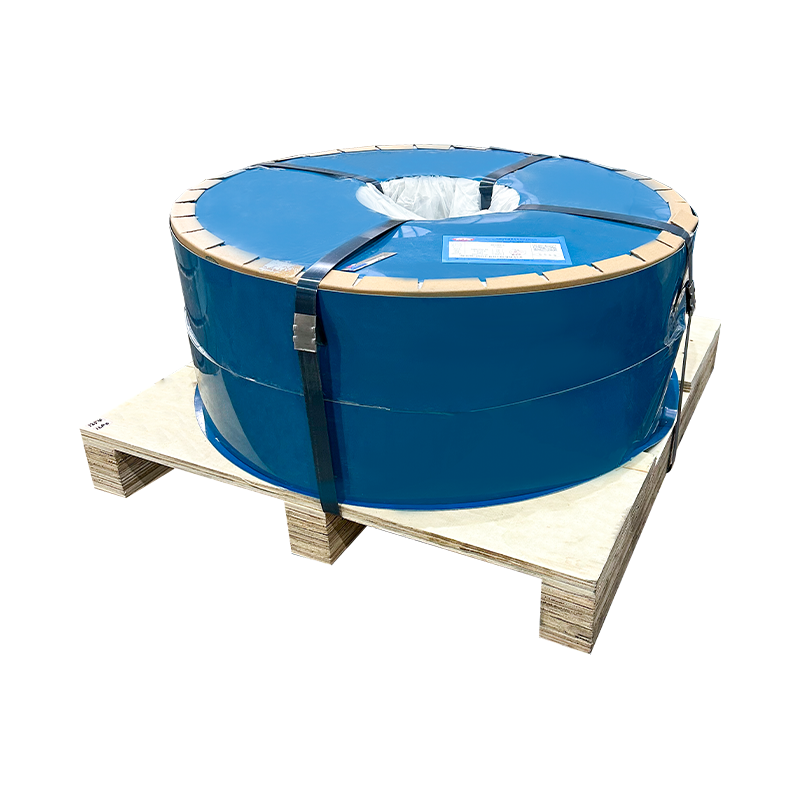
- Coil dimensions and packaging: Specify the coil inner diameter, maximum outer diameter, and maximum coil weight to ensure compatibility with your decoiling and feeding equipment. Also specify any requirements for paper or plastic interleaving between strip layers for surface protection during storage and transit.
- Mill certificate and traceability requirements: Specify that a full mill test certificate (EN 10204 Type 3.1 or Type 3.2 as appropriate) must accompany each coil, including chemical composition, mechanical properties, and dimensional inspection results traceable to the individual coil by heat and coil number.
Working with established specialty steel strip distributors or direct mill sources who have demonstrable experience supplying precision spring strip — rather than general steel service centers who may not maintain the dimensional control and documentation standards required — significantly reduces the risk of material-related spring performance problems in production. Requesting reference customers in comparable spring applications and auditing the supplier's slitting and quality control capabilities before approving a new source are prudent steps for any application where spring performance consistency is commercially or functionally critical.
 Previous


