


 English
 русский

Content
- 1 What Is 301 Stainless Steel and Why Does It Work So Well for Springs?
- 2 Cold Rolling Temper Grades: What They Mean for Spring Design
- 3 Key Mechanical Properties Across Temper Grades
- 4 Dimensional Specifications: Thickness, Width, and Tolerance Requirements
- 5 Surface Finish and Its Role in Spring Fatigue Performance
- 6 Corrosion Resistance Considerations for 301 Spring Strip
- 7 Selecting the Right 301 Strip Grade for Your Spring Application
Among the stainless steel grades used in precision spring manufacturing, 301 cold rolled stainless steel strip occupies a position of particular importance. Its ability to develop very high tensile strength through cold working — without the need for heat treatment — combined with good corrosion resistance, excellent formability in the annealed condition, and reliable spring-back behavior after forming makes it the material of first choice for a broad range of flat springs, coil springs, snap-action components, retaining clips, and other elastic elements across the electronics, automotive, medical device, and general engineering industries. This article examines the material science behind 301 stainless steel's suitability for spring applications, the temper grades available to spring manufacturers, the key mechanical and dimensional specifications, and the practical considerations that determine whether 301 is the right material for a specific spring design.
What Is 301 Stainless Steel and Why Does It Work So Well for Springs?
Grade 301 is an austenitic chromium-nickel stainless steel with a nominal composition of 16–18% chromium and 6–8% nickel, along with a relatively high carbon content (up to 0.15%) compared to other austenitic grades such as 304 (maximum 0.08% carbon) or 316 (maximum 0.08% carbon). This higher carbon content, combined with a lower nickel content than 304, gives 301 a metastable austenitic structure that transforms partially to martensite under the influence of cold deformation — a phenomenon known as strain-induced martensite formation.
It is this strain-induced martensite transformation that makes 301 uniquely valuable for spring applications. When 301 strip is cold rolled to progressively higher reductions in thickness, the austenite phase progressively transforms to martensite, and the tensile strength increases dramatically — from approximately 620 MPa in the annealed condition to 1,400–1,800 MPa or higher in fully hardened tempers. No furnace heat treatment is required to achieve these strengths; the cold rolling process itself is the hardening mechanism. This means that 301 strip can be supplied to spring manufacturers in a pre-hardened condition with precisely defined mechanical properties, ready for forming into the spring geometry without any post-forming heat treatment cycle.
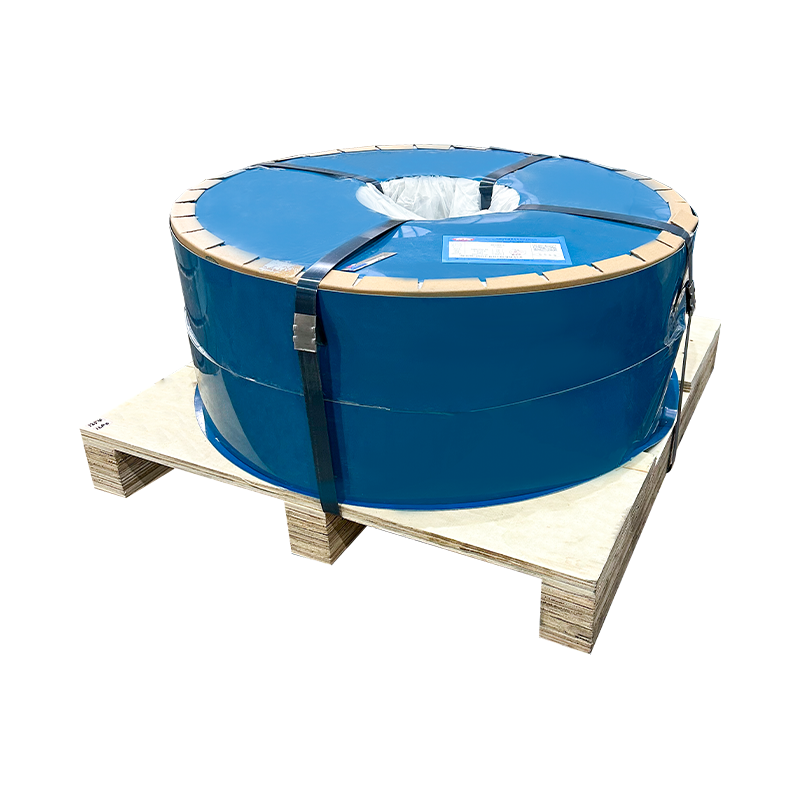
The elastic behavior of hardened 301 strip is characterized by a high yield-to-tensile strength ratio and consistent spring-back after deflection — exactly the properties required for reliable, fatigue-resistant spring performance. The magnetic character introduced by martensite formation (hardened 301 is moderately to strongly magnetic, unlike the annealed austenitic state) is a secondary effect that is inconsequential for most spring applications but should be considered in electronic applications where magnetic fields could interfere with component function.
Cold Rolling Temper Grades: What They Mean for Spring Design
Cold rolled 301 stainless steel strip for spring applications is supplied in a range of temper grades that correspond to different levels of cold work and therefore different combinations of tensile strength, yield strength, and residual formability. Understanding the temper system and selecting the appropriate grade for the spring application is one of the most important decisions in material specification.
The temper designations used in North America follow ASTM A666, while European suppliers commonly use EN 10151 designations. The principal temper grades for spring applications are:
- Annealed (Soft): Maximum formability, minimum strength. Tensile strength typically 620–820 MPa. Used when the strip must be extensively formed before the spring geometry is established, with the understanding that work hardening during forming will provide some increase in strength at the formed sections.
- Quarter Hard (1/4H): Light cold reduction providing a moderate increase in strength with good remaining formability. Tensile strength typically 860–1,030 MPa. Used for springs with moderate forming requirements and moderate load-bearing demands.
- Half Hard (1/2H): Medium cold reduction. Tensile strength typically 1,030–1,200 MPa. A widely used temper for flat springs, clip springs, and contact elements where a balance of strength and formability is needed. This is the most commonly specified temper for general spring applications.
- Three-Quarter Hard (3/4H): Heavy cold reduction. Tensile strength typically 1,200–1,380 MPa. Used for applications requiring higher spring force from a given section thickness, with limited forming during spring fabrication.
- Full Hard (FH): Maximum cold reduction. Tensile strength typically 1,380–1,650 MPa (and higher in some specifications). Minimum formability — bending at tight radii is not possible without cracking. Used for flat springs that require only simple bending or no bending at all, and for applications requiring the maximum elastic deflection per unit of material cross-section.
Key Mechanical Properties Across Temper Grades
| Temper Grade | Tensile Strength (MPa) | 0.2% Proof Stress (MPa) | Elongation (%) | Typical Hardness (HV) |
| Annealed | 620 – 820 | ≥ 275 | ≥ 40% | 170 – 220 |
| Quarter Hard | 860 – 1,030 | ≥ 515 | ≥ 25% | 250 – 300 |
| Half Hard | 1,030 – 1,200 | ≥ 760 | ≥ 18% | 300 – 360 |
| Three-Quarter Hard | 1,200 – 1,380 | ≥ 965 | ≥ 12% | 360 – 410 |
| Full Hard | 1,380 – 1,650+ | ≥ 1,170 | ≥ 8% | 410 – 480+ |
The 0.2% proof stress (yield strength) values are particularly important for spring design, as the elastic deflection range of a spring is bounded by the yield strength of the material — loading the spring beyond the point where stress in the most highly loaded section reaches the yield stress causes permanent set and loss of the designed-in spring force. Higher-temper grades offer higher yield stress, allowing a given spring geometry to sustain greater elastic deflection before yielding, which translates directly into greater spring energy storage capacity per unit of material volume.
Dimensional Specifications: Thickness, Width, and Tolerance Requirements
For precision spring applications, dimensional accuracy of the 301 strip is as important as its mechanical properties. Spring force is proportional to the cube of thickness (in flat spring calculations) and directly proportional to width, meaning that small deviations from nominal thickness have a disproportionate effect on the spring rate of the finished component. A thickness variation of ±5% in a flat spring translates to a spring force variation of approximately ±15% — which is unacceptable in any application requiring consistent spring performance.
Cold rolled 301 stainless strip for precision spring applications is supplied to tight thickness tolerances that are significantly tighter than hot rolled or standard cold rolled tolerances. Precision-rolled spring strip is commonly specified to ±0.005 mm or better for thin gauges (below 0.5 mm), and ±0.01–0.025 mm for thicker gauges up to 3 mm. Width tolerances for slit strip are typically ±0.05 mm for precision-slit material and ±0.1–0.2 mm for standard slit material. Edge condition — whether the strip has mill edge, slit edge, or deburred/rounded edge — affects the strip's ability to be formed without cracking at the edge and should be specified based on the forming operations the strip will undergo.
Flatness and camber (lateral curvature of the strip along its length) are additional dimensional parameters that affect feedstock handling in stamping and forming operations. Strip with excessive camber will track inconsistently through progressive die tooling, leading to misregistration and dimensional variation in the formed spring. Premium spring strip suppliers level the material after slitting to correct camber and achieve the flatness required for automated high-speed press feeding.
Surface Finish and Its Role in Spring Fatigue Performance
The surface condition of 301 cold rolled strip has a direct effect on the fatigue life of springs manufactured from it. Fatigue cracks in springs almost always initiate at surface defects — scratches, pits, inclusion exposures, or surface roughness peaks that act as stress concentrators under cyclic loading. In applications where the spring undergoes millions of deflection cycles — contact springs in connectors, springs in valve actuators, retaining springs in mechanisms subject to continuous vibration — the surface quality of the strip stock is a primary determinant of service life.
Cold rolled 301 spring strip is available in several surface finish grades. The bright annealed finish (BA), produced by annealing in a hydrogen or nitrogen atmosphere rather than air, provides a highly reflective, smooth surface with minimal oxide scale and good freedom from surface defects. The 2B finish — cold rolled, annealed, and lightly skin-passed — is the most common commercial finish and provides a smooth, slightly reflective surface suitable for most spring applications. For the most demanding fatigue applications, mirror-polished or precision-ground strip provides the lowest surface roughness and the greatest freedom from surface defects, at a significant premium in cost.
The presence of surface inclusions — particles of oxides, sulfides, or other non-metallic phases incorporated into the surface during steelmaking or rolling — is a quality concern specific to premium spring applications. Inclusion-free or low-inclusion grades of 301 strip are produced by steelmakers using vacuum degassing and clean steel practices, and these grades command a premium price but provide demonstrably better fatigue performance in demanding applications. Specifying material with ultrasonic or eddy current inspection certification provides additional assurance of freedom from subsurface defects that could initiate premature fatigue failure.
Corrosion Resistance Considerations for 301 Spring Strip
While 301 stainless steel provides good corrosion resistance for most spring applications, its corrosion performance is lower than grades 304 or 316 due to its lower chromium and nickel content and the presence of martensite in the hardened condition. Martensite has slightly lower corrosion resistance than austenite, and the strain-induced martensite in hardened 301 strip can make it more susceptible to pitting corrosion in chloride-containing environments compared to fully austenitic grades.
For indoor, dry, or mildly corrosive environments — which describe most electronics, office equipment, automotive interior, and general engineering applications — the corrosion resistance of hardened 301 strip is entirely adequate, and no additional protective treatment is required. For outdoor, marine, or moderately aggressive chemical environments, the corrosion performance of 301 should be evaluated against the service requirements, and alternative grades (304, 316, or precipitation-hardening grades such as 17-7 PH) should be considered if 301's corrosion resistance is insufficient. The good news is that the passive oxide layer on 301 stainless steel is self-repairing in the presence of oxygen — if the surface is scratched or damaged, the chromium oxide layer reforms spontaneously, providing ongoing corrosion protection without any treatment.
Selecting the Right 301 Strip Grade for Your Spring Application
When specifying 301 cold rolled stainless steel strip for a spring application, the following decision sequence covers the key parameters that should be defined in the material specification:
- Define the required spring force and deflection range: From the spring design calculation, determine the minimum yield strength and elastic modulus required to achieve the target spring rate and maximum elastic deflection without permanent set. This determines the minimum temper grade — if the spring design requires a minimum yield strength of 900 MPa, half hard or higher is required.
- Assess forming severity: Evaluate the most demanding forming operation in the spring fabrication process — the tightest bend radius relative to material thickness, the most complex shape change, the most severe blanking or drawing operation. For tight-radius bends (R/t below 1), annealed or quarter hard material may be required. For simple bending or blanking with no bending, full hard material can be used without forming problems.
- Specify dimensional tolerances based on spring force sensitivity: Calculate the effect of thickness and width tolerance on spring force variation for your spring geometry. For springs where force consistency is critical, specify precision-rolled tolerances and require dimensional certification with each shipment.
- Specify surface finish based on fatigue requirements: For springs with cyclic loading requirements, specify minimum surface finish (Ra value) and require certification of freedom from surface defects by eddy current or visual inspection. For cosmetic springs or springs with low-cycle loading requirements, standard 2B finish is generally adequate.
- Confirm corrosion resistance adequacy for the service environment: If the spring will be exposed to chlorides, acids, or high humidity, evaluate whether 301 provides adequate corrosion resistance or whether a more corrosion-resistant grade is required. Request corrosion test data from the supplier if the service environment is aggressive.
 Previous


